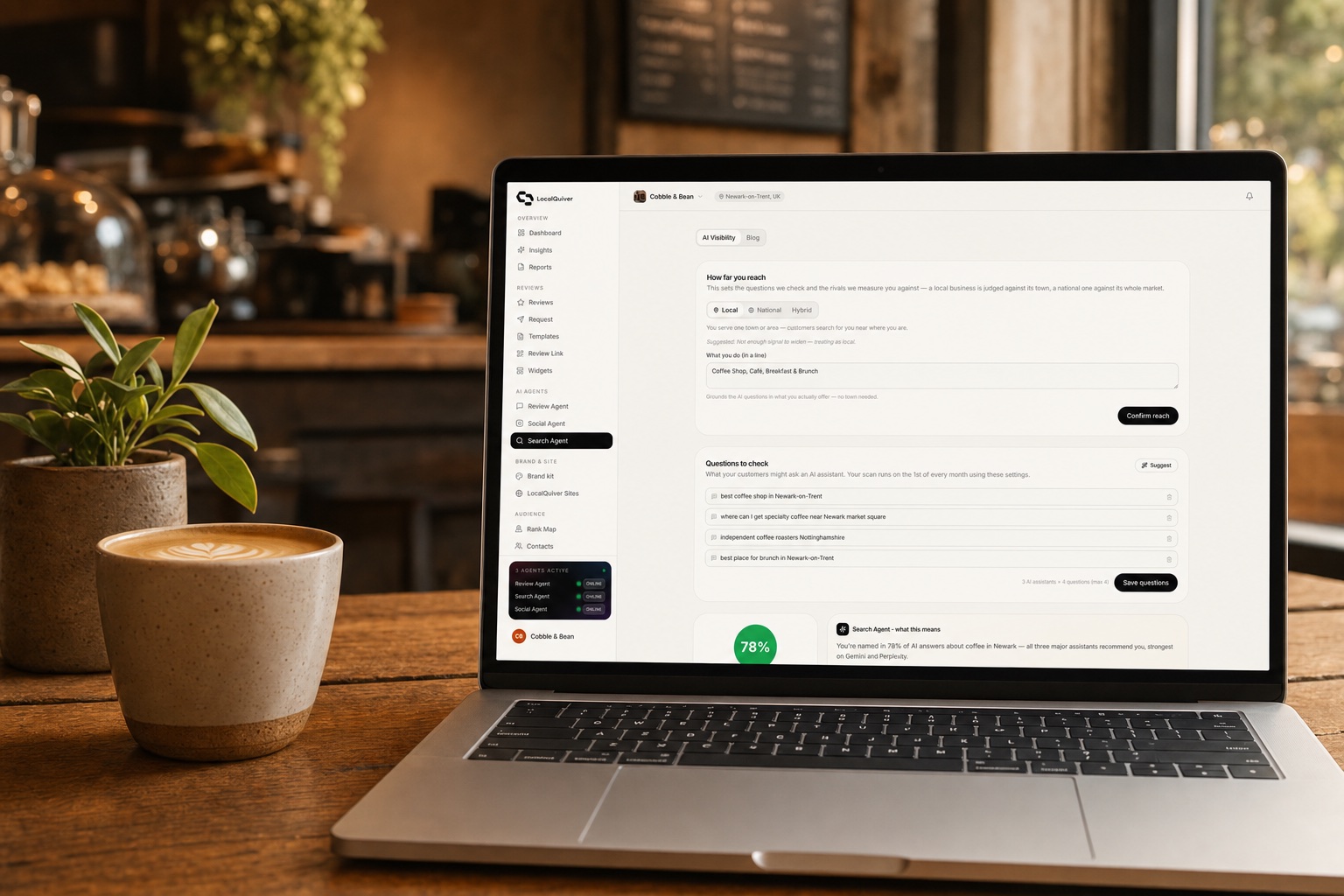
Topics planned around your town and trade, articles written from your own reviews, every one landing as a draft you read first.
When somebody nearby searches for what you do, you'd like to be what they find. The usual answer is a blog: articles nobody asked for, written by nobody in particular, published in one burst of enthusiasm and abandoned by March. Search engines have read a million of those. So have your customers.
We go at it differently, and the difference is your reviews. Topics are planned around your Google categories, your town and the places you cover, then checked against what people actually search for — so nothing gets written just to fill a slot in a calendar. Each article is then written from your own reviews, quoting customers as they wrote it. Actual jobs, actual places, told in the words of the people who were there.
Where the topics come from
Three ingredients. Your Google categories say what you are. Your town and the places you cover say where you are. And real searches say what people near you genuinely want to know. A topic has to earn its place against all three before a word gets written, which is why the plan comes out narrow and local rather than long and generic. It's the difference between 'five tips for choosing a tradesperson' and a page about the work you actually do, in the places you actually do it.
The articles that follow read less like content and more like answers — the questions your customers were already asking, answered partly by your other customers, in quotes lifted straight from your reviews.
Drafts first, at your pace
Nothing publishes itself. Every article lands as a draft for you to read first — change it, approve it, or bin it. Each draft arrives with its own picture, ready to go as it stands. You choose the pace and it holds to it: every three days, weekly or fortnightly. Fortnightly and steady is a perfectly good answer, by the way; the rhythm you'll keep beats the rhythm that impresses.
If your blog is on WordPress, articles publish straight there once you're happy. And if we've built your website, its journal is exactly where these articles live.
The honest edges
Nobody honest promises you a spot on page one of Google, and we won't either. What you get is the steady work underneath: pages about your trade and your town that a real customer would recognise as true.
The articles are built from your reviews, so they're only as rich as the reviews are. Thin reviews make thin articles. If the reviews aren't there yet, getting them in comes first — it's the first thing we set up for a reason.
Customers are quoted as they wrote it, odd commas and all. That's what makes the quotes believable, and we won't tidy them into marketing speak.
WordPress publishes directly. A blog living anywhere else means copying the drafts across yourself — better to hear that here than find out later.
This is a steady game, not a switch you flip. Anyone who tells you otherwise is selling something we're not.
Your reviews already explain why people choose you, one job at a time. This puts those explanations where the next customer is actually looking.
We ask your customers for you, by text or email, in your words. Follow-ups chase as many times as you set, and stop when someone acts. We never screen anybody: there is no star question, so everyone sees the Google button, happy or not. Beside it, a private feedback button that comes straight to you, never published. They can also record a two-minute video testimonial, ticking the consent box themselves.
Replies are drafted in your voice: tone, length, sign-off. Approve each one, or let Autopilot answer Google reviews above a rating you choose, inside your working hours. It answers only reviews arriving after you switch it on, unless you ask it to work back through old ones. Trustpilot, TripAdvisor and Facebook can't be replied to automatically. We write the reply and take you to the review to paste it in.
A five-star review shouldn't sit on Google doing nothing. Turn one into a post, square, portrait or a story, in your colours with your logo. Send it to your Google Business Profile, Facebook, Instagram, LinkedIn or TikTok. The caption is written for you and you can change every word. It can also pick your best new five-star review and post it once a day, once every three days or weekly.
Six stamps and the seventh coffee is on the house, or points against rewards you name. The card sits in Apple or Google Wallet: nothing to download, their phone tells them when it's full. People join by scanning the A4 poster we print for your counter. On a quiet week, message the ones a stamp away: only those who ticked the box, never more than one message every three days.
Connect your Google Business Profile and the site builds itself from it: hours, photos, services, map and reviews, checked every hour. Change your Christmas hours on Google and the site follows within the hour. It's one long page, plus a journal written from your reviews, landing as drafts to read first. Nothing is live until you press publish, and nothing is shown to Google until you turn indexing on.
We plan topics around your Google categories, your town and the places you cover, then check them against what people actually search for. Each article is written from your own reviews, quoting customers as they wrote it, with its own picture. Posts land as drafts for you to read first. Choose every three days, weekly or fortnightly. If your blog is on WordPress, they publish straight there.