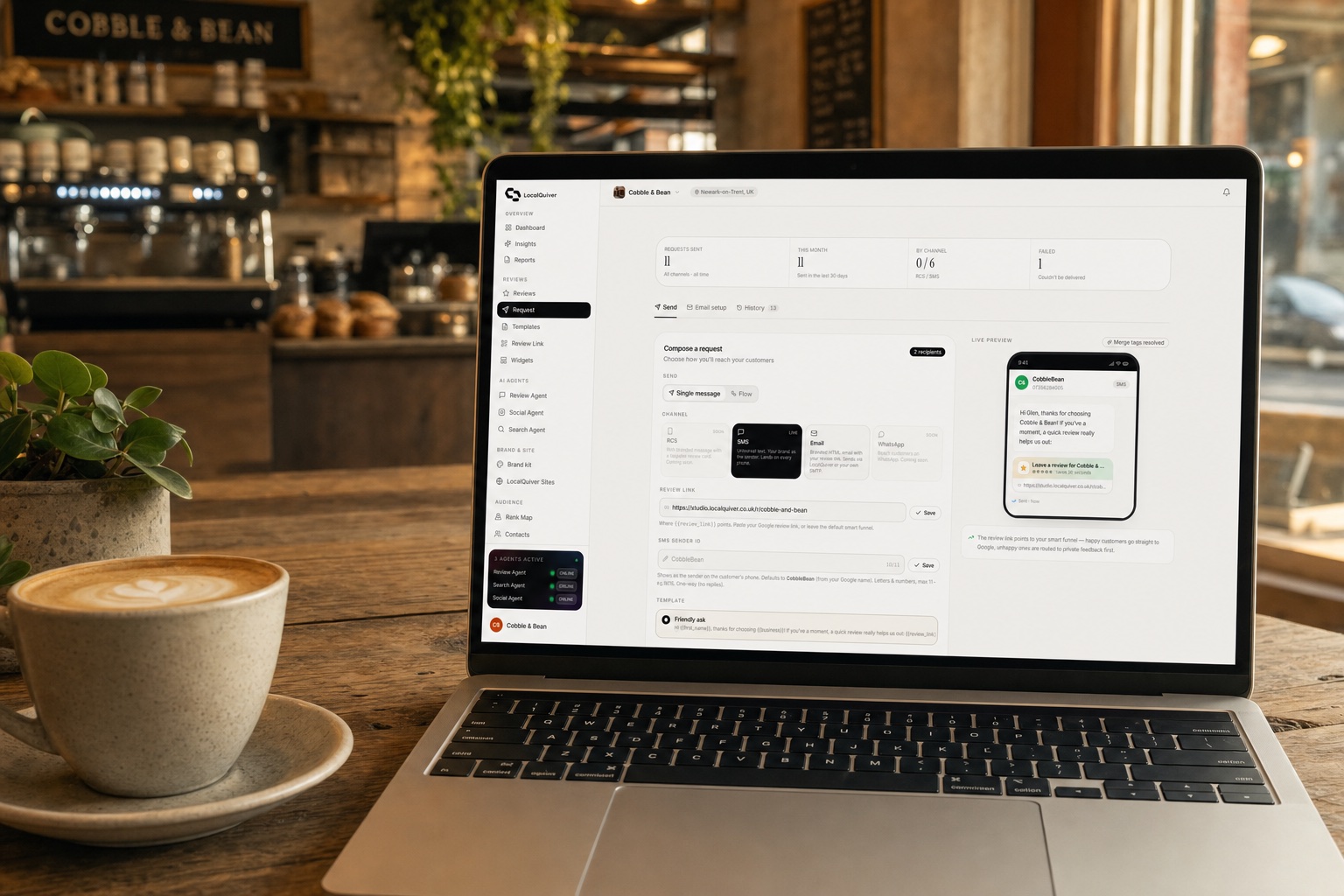
We ask your customers for you, by text or email, in your words — and everyone sees the Google button, happy or not.
Most of your customers are happy. Very few of them get round to saying so on Google. It isn't reluctance — the moment just passes. They mean to do it on the drive home, the phone rings, and the thought is gone. The businesses near you with hundreds of reviews aren't better at the work than you are. They ask every customer, and they follow up.
That's the job we take off your plate. We ask your customers for you, by text or email, in your words — not a template with your name dropped into it, but wording you've agreed, sounding like you. Follow-ups chase as many times as you set, and stop the moment someone acts. Nobody gets nagged after they've already left a review.
How the asking works
Add a customer — a name with a mobile number or an email address is all it takes — and the request goes out in your words. If nothing happens, a follow-up goes after it, and then another, up to however many chases you've set. The moment they act, the chasing stops, quietly and without fuss.
For the customers standing right in front of you, there's a branded review link with QR codes to match: one for the counter, one for each van, one for the bottom of the invoice. Wherever a customer happens to be when they think well of you, the same page is one scan away.
The setting up is on us — the wording, the follow-up rhythm, the page itself. You approve everything before it runs.
What your customer sees
One page, in your colours. On it, the Google button. Beside it, a private feedback button — whatever they write comes straight to you and is never published anywhere. And a third option: recording a video testimonial, up to two minutes long, with a consent box they tick themselves. No forms for you to send, no permissions to chase afterwards.
Here's the part we're stubborn about: everyone sees the Google button, happy or not. Some tools ask 'how many stars would you give us?' first, and only show the Google button to the fives. That's called review gating. It's against Google's rules, and it isn't honest. We never screen anybody. The private feedback button is an extra door, not a filter — plenty of people with a small grumble would rather tell you than tell the internet, and now they can. But the choice is always theirs.
The honest edges
We ask well and we chase politely, but nobody can make a customer leave a review. Some never will, however good the job was.
Because there's no screening, an unhappy customer can press the Google button too. That's the same deal every business on Google already has — the difference is that your happy customers finally get asked as well.
Private feedback stays private. It comes to you, it's never published, and it never will be.
The video testimonial happens only if the customer wants it to. They record it, they tick the consent box; nothing is used without that tick.
None of this is clever. It's the boring, consistent asking that most businesses never keep up — done for you, in your words, without cutting a corner on who gets asked.
We ask your customers for you, by text or email, in your words. Follow-ups chase as many times as you set, and stop when someone acts. We never screen anybody: there is no star question, so everyone sees the Google button, happy or not. Beside it, a private feedback button that comes straight to you, never published. They can also record a two-minute video testimonial, ticking the consent box themselves.
Replies are drafted in your voice: tone, length, sign-off. Approve each one, or let Autopilot answer Google reviews above a rating you choose, inside your working hours. It answers only reviews arriving after you switch it on, unless you ask it to work back through old ones. Trustpilot, TripAdvisor and Facebook can't be replied to automatically. We write the reply and take you to the review to paste it in.
A five-star review shouldn't sit on Google doing nothing. Turn one into a post, square, portrait or a story, in your colours with your logo. Send it to your Google Business Profile, Facebook, Instagram, LinkedIn or TikTok. The caption is written for you and you can change every word. It can also pick your best new five-star review and post it once a day, once every three days or weekly.
Six stamps and the seventh coffee is on the house, or points against rewards you name. The card sits in Apple or Google Wallet: nothing to download, their phone tells them when it's full. People join by scanning the A4 poster we print for your counter. On a quiet week, message the ones a stamp away: only those who ticked the box, never more than one message every three days.
Connect your Google Business Profile and the site builds itself from it: hours, photos, services, map and reviews, checked every hour. Change your Christmas hours on Google and the site follows within the hour. It's one long page, plus a journal written from your reviews, landing as drafts to read first. Nothing is live until you press publish, and nothing is shown to Google until you turn indexing on.
We plan topics around your Google categories, your town and the places you cover, then check them against what people actually search for. Each article is written from your own reviews, quoting customers as they wrote it, with its own picture. Posts land as drafts for you to read first. Choose every three days, weekly or fortnightly. If your blog is on WordPress, they publish straight there.